
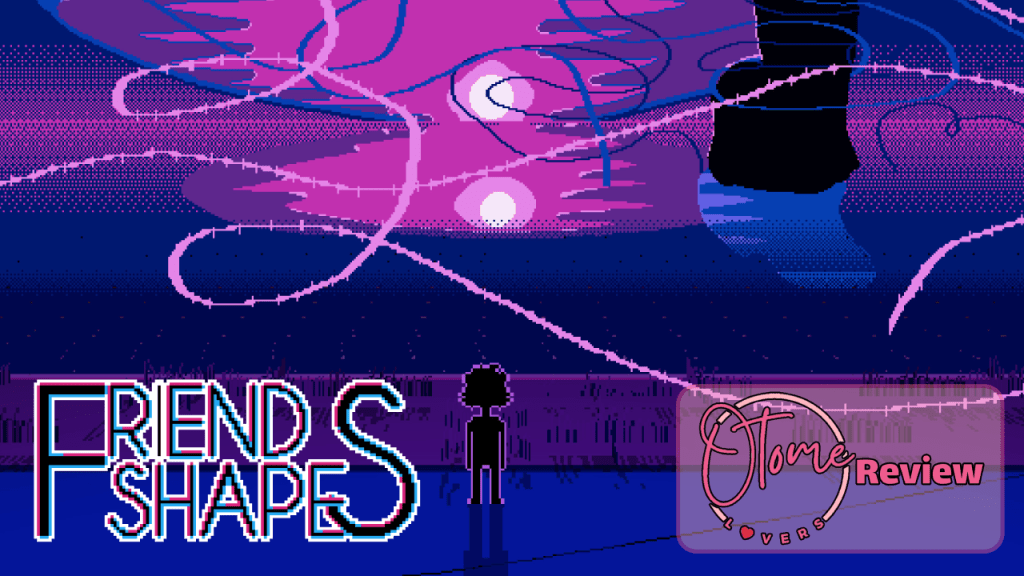
FriendShapes is a beautifully eerie horror RPG that has you explore Digressions and encounter mysterious Shapes. With a gripping soundtrack and excellent art, its world building is unforgettable.
Introduction
Despite the name of the engine, RPGMaker has been used to make several genres of games. One of the most common is horror. Out of the types of horror games that RPGMaker has been used for, I find one in particular difficult to describe. It’s a mix of quirky with creepy, making distinct games that don’t quite fit into any single category. Indie games that I would use this loose label for are: LISA, No Delivery/Sorry We’re Open, OFF, OMORI, and UNDERTALE. That’s the closest I can come to describing the genre FriendShapes falls into, but those aren’t perfect either. FriendShapes stands on its own, and that uniqueness resulted in it being one of my favorite games.
Some elements that make up FriendShapes include RPG elements, randomized ‘dungeons’ with a variety of events, and unsettling horror with no jumpscares. I liked those elements, but those alone wouldn’t be enough for me to call it a favorite. The world and how its medium enhanced it is what makes FriendShapes special. Its storytelling, graphics, music, and gameplay all create a setting that has stuck with me ever since playing it, even if it has some flaws along the way.
Story
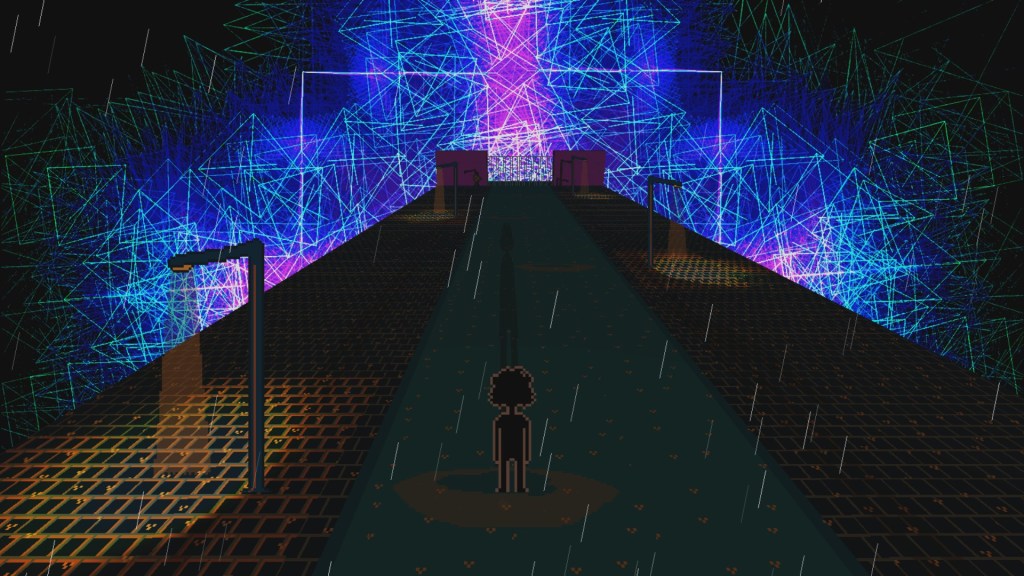
The story of FriendShapes is ambiguous, making it difficult to piece together. At the start, all you know is that your protagonist seems to be new to this strange world. Your character, Glad, meets a curious individual in a hazmat suit. That individual, Edmonton, offers Glad a brochure that explains they are in Leavalley. This small section of buildings is the closest thing to a town left in the world. Going anywhere else leads to eerie landscapes with only the occasional bystander to speak with. To understand more about where they are, Glad has to visit these areas and enter ‘dungeons’ called Digressions. The player will receive narrative clues as they go about what happened to the world and its inhabitants, along with some hints as to who Glad is.
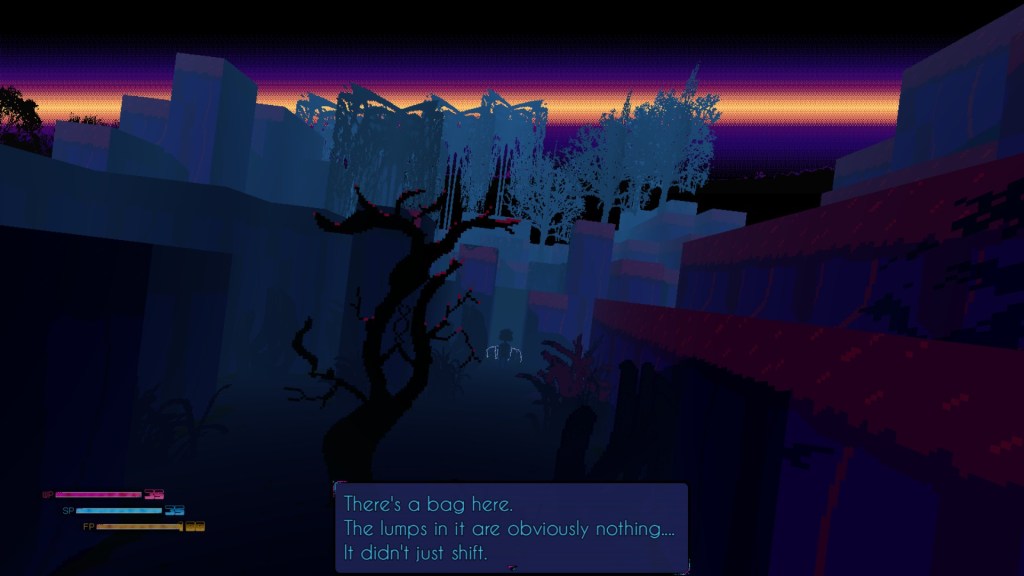
In terms of a plot, you aren’t going to get much here. What I found captivating was the setting and characters. The two go hand-in-hand since the setting is defined by the individuals (called Shapes) living in it and vice-versa. As an example from the first Digression, dark and twisted forest would not be nearly so significant if it didn’t have Shapes such as the giant creatures stomping in the background, humanoid shapes that can only mimic the words of past visitors, and gruesome meat houses with inflatable men trying to lure Glad within. The Shapes on their own, however, would not be quite so chilling if they lacked this environment. Bloody rivers that block Glad’s path, crystalline trees that cut through them if brushed the wrong way, and abandoned bags with something incredibly wrong lurking within are all unsettling compliments to the alien lifeforms within. It is from these pieces that a story can be formed. What fate did those mimicked individuals suffer? Where did these bizarre bags come from? Why did a Timeless Chorus get immortalized in a lake? I loved finding bits of lore that confirmed certain theories while leaving the rest to my imagination.
This sort of abstract storytelling can be a deal breaker for some. If you are a player who prefers everything being laid out, then the ambiguity in FriendShapes will most likely be off-putting. It’s not for everyone, but it fits my tastes nicely. Should you enjoy pondering over such a setting and its inhabitants, that would be worth a recommendation on its own.
That being said, there is a flaw that ties into the notes you can find. The writing in this game could have used a good proofreading. It’s not horrendous, and I was able to understand what was being said. Still, I noticed a lot of small typos that would have benefitted from a clean-up.
Graphics
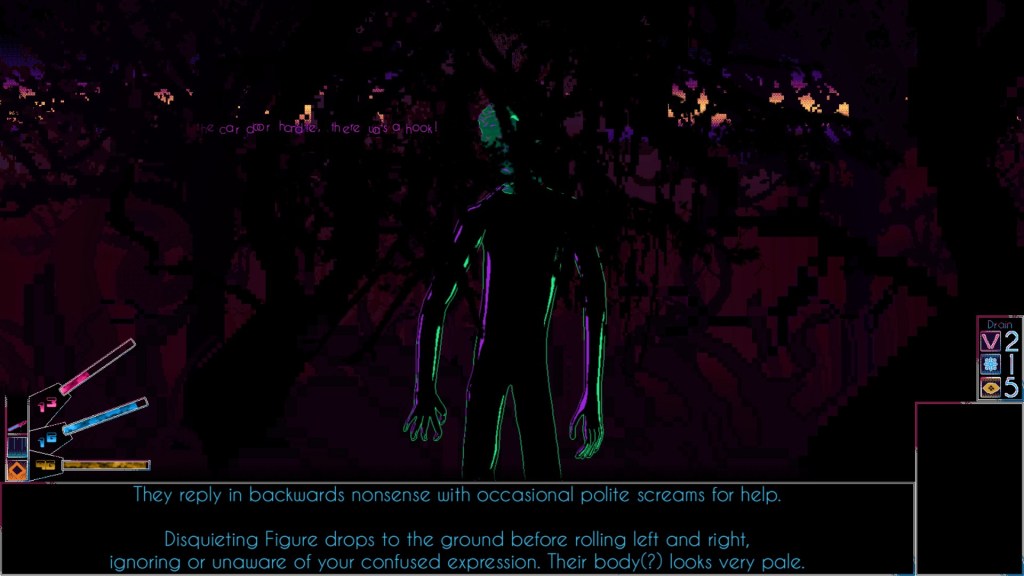
At an initial glance, FriendShapes seems to have been made solely with pixel art. That is quickly proven wrong upon entering Encounters with the Shapes. Each Shape has sprites on the map, but they have full drawings in the Encounters. These drawings add to the sense of wrongness with this world’s inhabitants. Some of them also use contrasting art such as realistic eyes, blurry shadows, and 3D effects. It makes the Shapes feel distinct while also connecting them. The neon color schemes, curvature of the lines, and not-quite-right nature of the creatures made them really stand out to me. I can’t think of any other game I’ve played that’s used this kind of art style. Since I’m a fan of pixel art and I like the Shape designs a lot, the graphics helped enhance the experience for me. The Shape designs have clever elements to them that I can’t get into without spoiling elements of the game, but I’ll note that Pursuant has my favorite design. Once you know the story behind that Shape, its appearance is both brilliant and heart-wrenching.
I also found the out-of-combat graphics to be striking. The overworld has a gloomy air to it that is amplified by its multi-colored sky and abandoned buildings. The Digressions are distinct from one another in terms of color and atmosphere, giving a different sense of eeriness to each location. Since Digressions have randomized layouts, players will see rooms repeated on return visits, but there is enough variation to keep them from feeling too much alike. What I found most impressive was some of the effects that the developer pulled off with this RPGMaker MV game. There are visuals that twist the backgrounds and cause impressive 3D effects, something that I imagine is difficult to do with this engine. It certainly adds to some of the locations, especially the final Digression.
My only personal gripe with the graphics is that some games trigger motion sickness in me. FriendShapes avoided that for the most part, yet the final section of the last Digression was almost impossible for me to complete due to how the screen rocked. It wasn’t a short section either, so I was having to look away every minute or so to keep my stomach intact. I don’t know how badly this would affect the majority of players as I’m more sensitive to certain stimuli than the average person. Still, I wish that effect had not been included, especially in an area that was basically a maze.
It’s also worth noting that when I shared some pictures with friends, they said they had difficulty reading some of the colored text. This mainly applied to purple text against a black background, though I’m willing to bet that with how many colors are used for text in this game, there would be other problematic combinations. I had no issues with reading the text, but that could definitely hamper a player’s enjoyment. You would be missing out mostly on flavor text, so that would not stop a player from proceeding in the game. Yet with the flavour text being so good, it would be a shame to not be able to read it.
Sound
One of my favorite aspects of FriendShapes is its soundtrack. It has a distinct feeling to it that very much differs from most OSTs I’ve heard. I’m not talented at describing music, so the best I can do here is say that it does a tremendous job at expanding the experience. The music during the overworld and Digression sections enhances the eerily desolate areas you travel through. That on its own is great and would get a thumbs up from me.
However, that isn’t the star of the show. What makes the soundtrack shine is that every Shape has its own piece of music. This isn’t an RPG where there is a theme for common enemies, one for bosses, and maybe a couple of variations. When I say they are all unique, I mean it. With at least fifty Shapes in this game, that is a lot of great music to listen to.
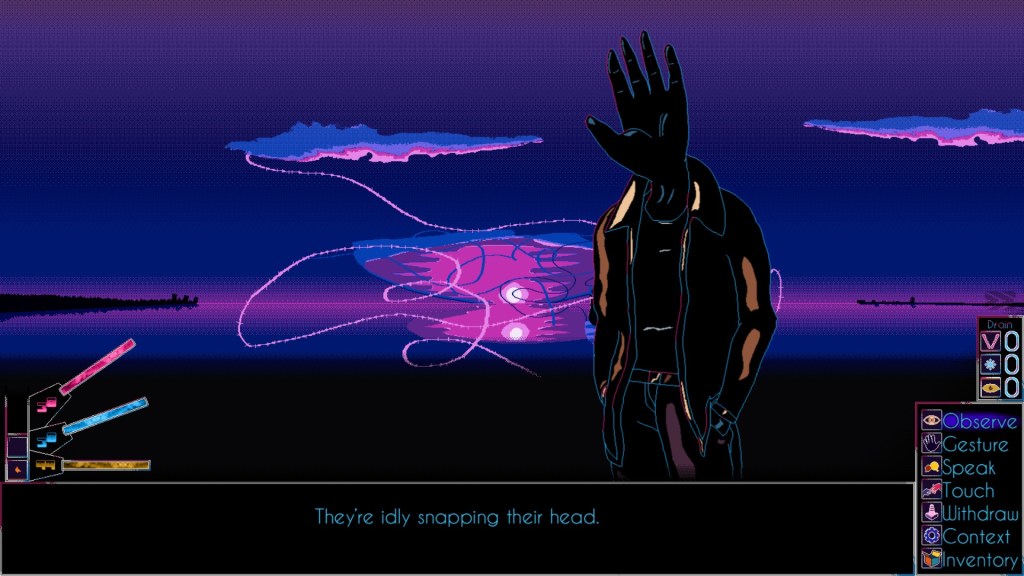
I find this music particularly special because it adds a layer of characterization to the Shapes. For example, Hifive’s is a chill soundtrack with snapping fingers to showcase their mellow nature and hand-shaped head. Contrasting this is the Huh?Man, which is full of alien noises and interspersed with background laughs and screams to amplify their bizarre nature and how they are trying to pass as a human. I found Illinveiglecium’s (yes that’s the name of a Shape) to be especially effective due to having a tune that reminded me of a merry-go-round, or perhaps an ice cream truck tune. Since that Shape is used by another Shape (The Collective) to lure in victims, those enticing tunes add to how disturbing this duo of Shapes is.
With how subjective music is, I can’t say how many players will feel the same as I do. What I can guarantee is it’s different from almost any other game soundtrack you’ll hear. The developer being responsible for the soundtrack as well is another reason I find this game impressive. This was mostly a single-developer project and it shows from their cohesive vision. The writing, art, and music for each Shape is carefully thought out and fantastically executed.
Gameplay
So we come to the final factor I’ll be discussing: the gameplay. FriendShapes has a lot of elements to it that I’ll briefly summarize. To start, note that mouse and keyboard is usable, but that the developer recommends a controller. I do as well. I used a PS3 controller and it felt far smoother than the keyboard and mouse, which I tried in my second playthrough for comparison’s sake. If a controller is unavailable or the player does not wish to use one, the keyboard and mouse set-up does the job well enough and should not be a singular factor to deciding whether to play FriendShapes or not.
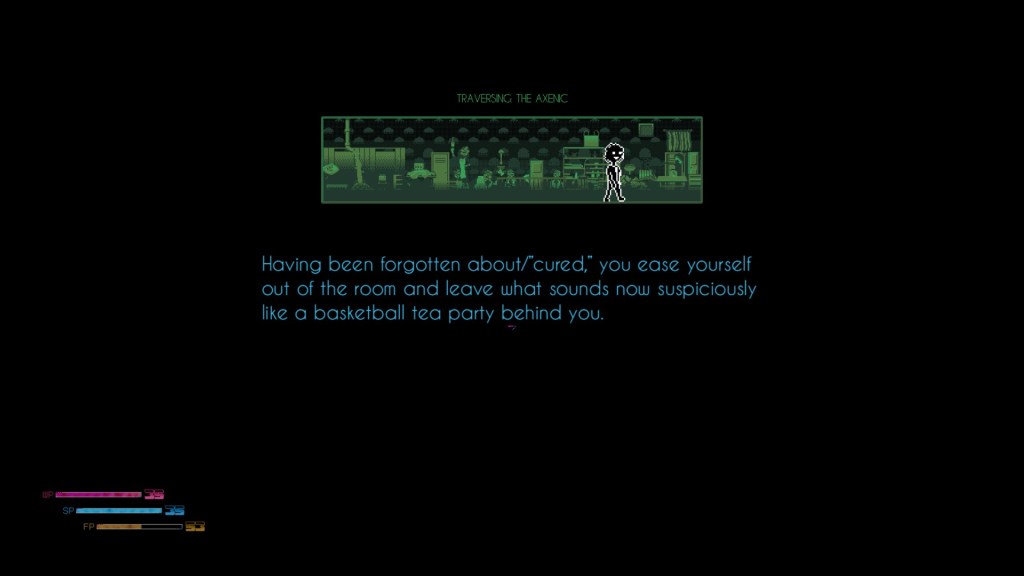
Next, the overworld element merely has you walking around from location to location with some Shape encounters, so there isn’t much to say about that. Digressions are much more important. As mentioned, they are this game’s version of dungeons. You go through several areas with each having various elements. They might have NPCs to talk to, items to collect, or obstacles to get past. Of particular interest is that events occur between each area. In the forest, a few examples are that you might find mushrooms you have to deal with, a hunter who shoots you for massive damage, or a scalp dangling from a branch for you to take. The order of the areas and events are randomized, and there are enough to make it impossible to see everything in one run through a Digression.
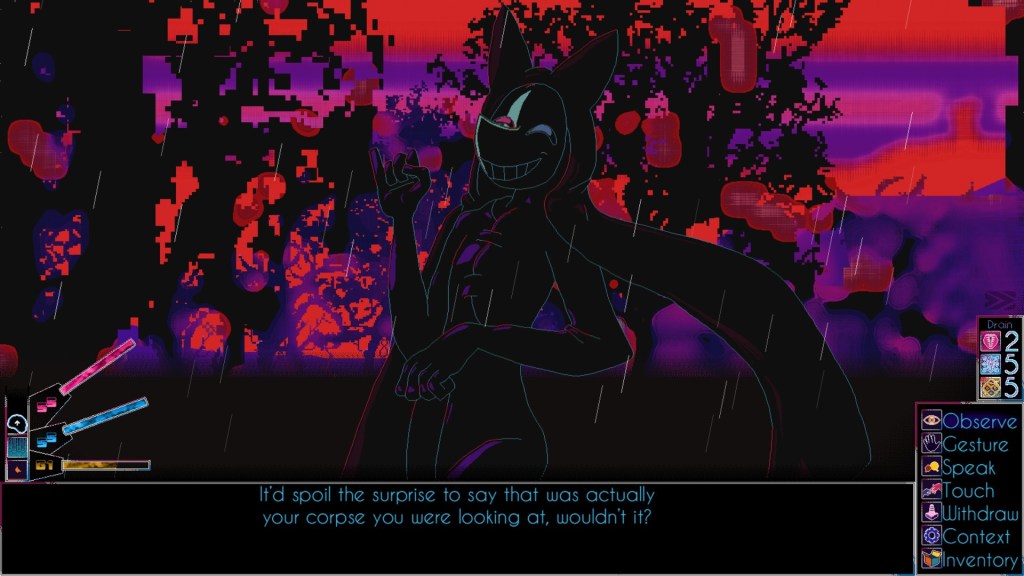
This also means that the Shapes you encounter are not always going to be the same batch. What is not randomized is how you can interact with them in their encounters. FriendShapes doesn’t have battles in the traditional sense. With each encounter, you negotiate with the Shapes in different ways. Sometimes they mean you no harm, even if simply being in their vicinity drains your mental wellbeing. Others are most certainly ready to horrifically mutilate you. Learning how to handle each Shape is a core part of the game. To reference some earlier Shapes, Hifive is simply an individual you can talk to for information. The Huh?Man has to be either agreed or disagreed with depending on what they say; respond incorrectly and they’ll throw a tantrum. As for The Collective, gods help you if you screw that encounter up. They will whittle away your memories like watching a tape, grating all of it away as they spectate and laugh about it. This replacement for traditional combat is both fun and another way to individualize each Shape. That’s why I said that FriendShapes uses its medium as a video game well. With the setting, character designs, music, and specialized interactions, the Shapes have so much more personality than they would anywhere else.
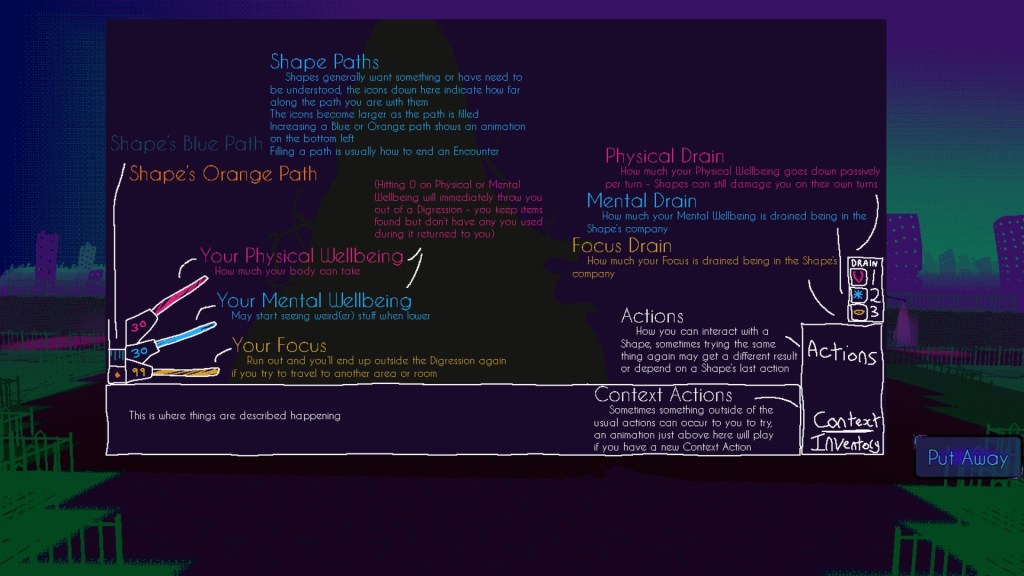
In terms of finishing each Digression, Glad has three values that need to be carefully monitored: Physical, Mental, and Focus. Think of them like HP bars in most RPGs. The majority of Shapes will lower these bars by interacting with them. Some events in Digressions will heal or hurt Glad in different ways. You also get a generous amount of items to heal with. Since you can only carry nine of each item, it’s encouraged to use them so as to have space for more. I rarely use items in RPGs unless it’s a game that expects you to in its difficulty curve, and FriendShapes is one of those games. With that in mind, I did not find this to be a hard game to finish. Trial and error with the Shapes is usually not too punishing, and once you learn how to deal with them, you’re in pretty good shape.
However, I have some complaints to wrap this up with. One is that I sometimes had a difficult time opening doors in a certain Digression. Even if I was facing the door and pressing the button, I would have to keep shuffling around to try and get it to let me in. I’d say this only happened about 5% of the time, but if you’re running through that Digression a lot, it adds up quickly. To connect to that, there is a point in the game where you have to revisit the first few Digressions to get items for a character. I ran through the Digressions a lot because I wanted to explore them, but forcing the player to go back for this purpose isn’t great. It’s especially annoying that you can find those items earlier on but can’t take them at the time. Finally, I felt some of the Shape encounters dragged on too long in repeat run-ins. As creepy as The Collective is, that Shape takes two full length encounters that you can’t skip, so it quickly outstays its welcome. This is thankfully a rarity since most Shapes are quick to get past when you know how to handle them. There was one particularly egregious example with an encounter in the final Digression where it took several minutes to finish. I believe this got patched recently to be reduced in tedium, but I haven’t had a chance to check for myself. It’s a cool encounter on a base level, so hopefully that did indeed get adjusted.
Conclusion
FriendShapes is not a game for everyone. Given its abstract nature and potentially repetitive loop, I can understand why some wouldn’t care for it. That being said, I personally loved FriendShapes for its in-depth world, memorable characters, and haunting atmosphere. If it sounds the least bit interesting to you, I recommend checking out its demo. If nothing else, I’m very glad that I got to experience this game in all its bizarre glory.
Otome Lovers wishes to thank RainingLamppost for providing a free review copy for this game through our other group, The Butterfly Effects.
Abridged review posted on Steam ➞
Please follow our curator page, Otome Lovers, if you’d like to see more reviews like this one!


 Otome Lovers
Leave a comment