
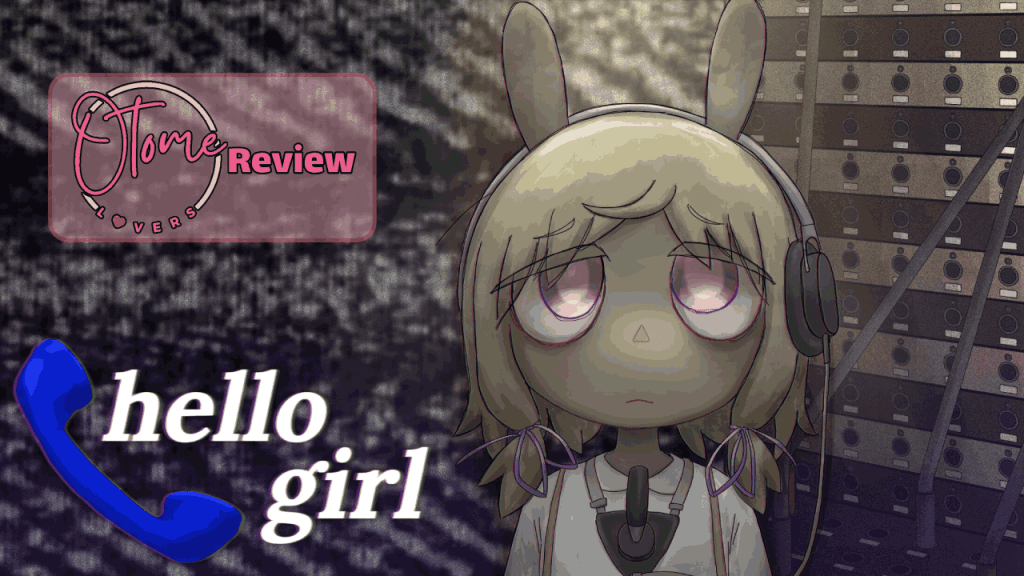
Hello Girl tells the story of an isolated young bunny girl who lives in turbulent times. The melancholic world is wonderfully displayed via atmospheric art, calming music, and beautiful writing.
Introduction
Sometimes you come across a game that you have no particular expectations of, only for it to completely blow you out of the water. That was my experience with this kinetic visual novel, Hello Girl. If you like kinetic visual novels and what is on the Steam page is enough to interest you, stop reading this review right now and go buy it. Should you want more information, I’ll give it as best as I can without revealing too much.
Story
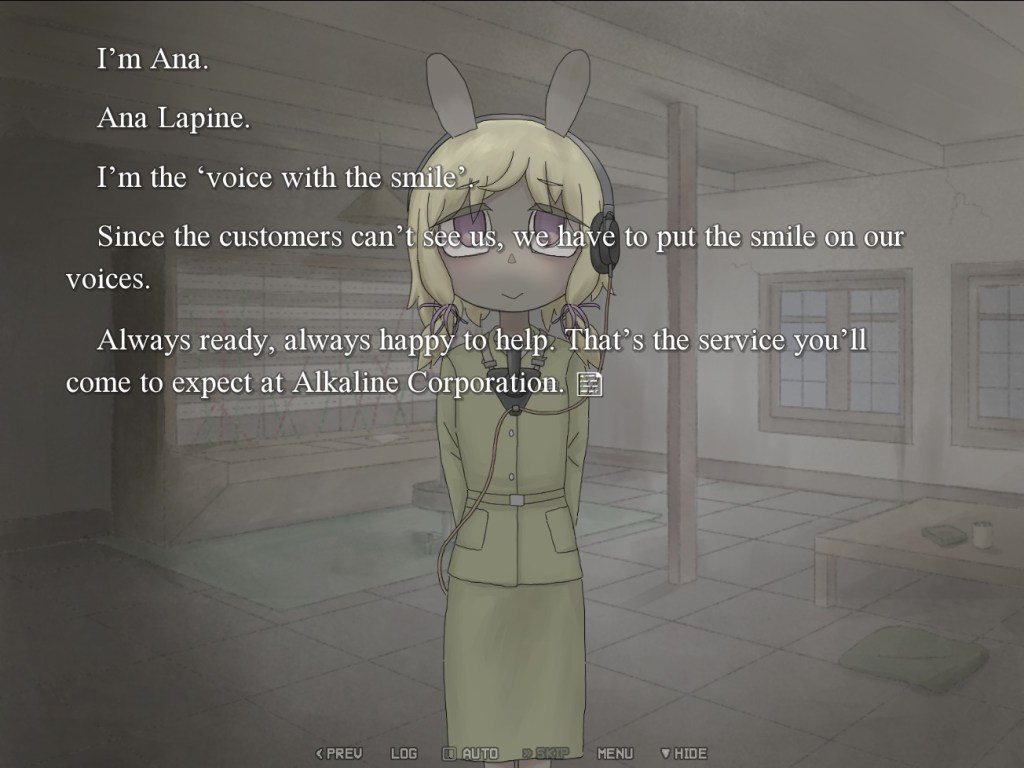
If you’re playing a kinetic visual novel, odds are good that you’re doing so primarily for the story and characters. These are the highest points of Hello Girl among a mountain range of peaks. I don’t want to give much away here so that players can go in with little information. As such, I’ll keep it to a short summary.
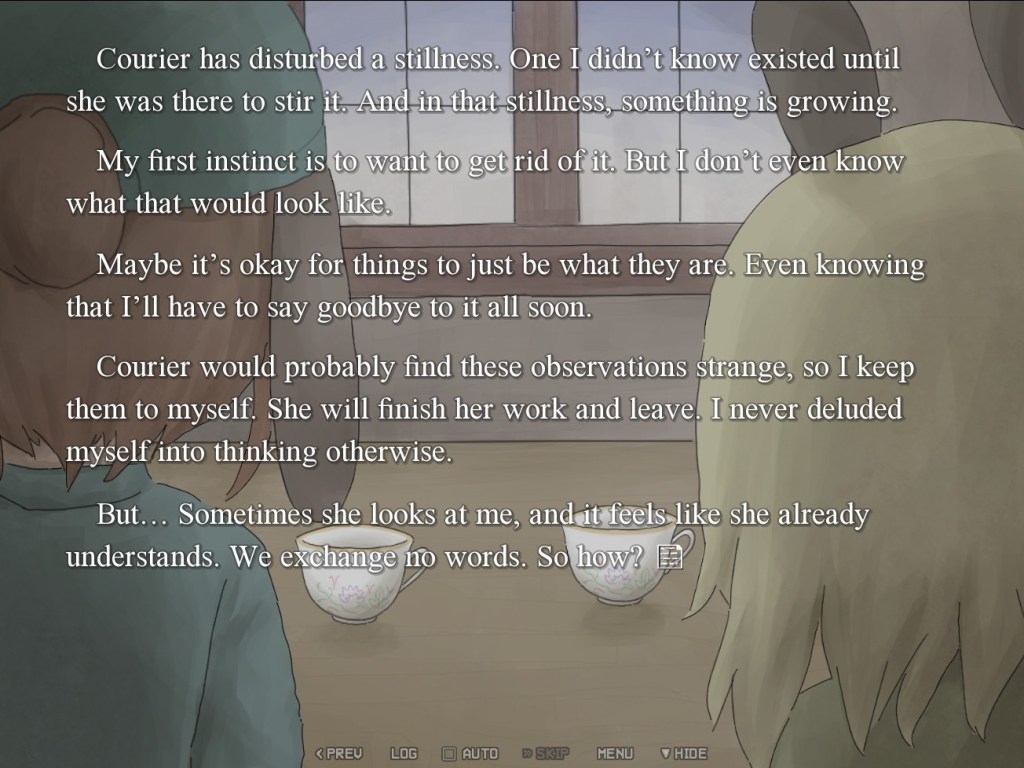
You follow Ana Lapine, a bunny girl (I’m sure you’re shocked given her last name) in a world full of bunny girls. Ana serves as a call operator by connecting calls via a switchboard. Her unchanging life is interrupted by a letter saying that maintenance is going to be done on her work station soon. The repair person that her company sends, Courier, winds up talking with her more than Ana expects. This gives Ana a connection to someone for the first time since her sister left to take part in the ongoing war. The focus remains on these two characters bonding and doing the best they can in their isolated location while the war rages far from them, yet with effects that cannot be ignored.
That might sound like a simple premise, and in some ways it is. Yet Hello Girl masterfully fleshes out its world while keeping to a small pocket of it. When exposition is used, it’s done in a natural manner, mostly through Ana’s thoughts and her learning of a wide world that she knows little about. While the story has its intriguing moments and kept me locked in, the characters were the real stars. I grew to love both Ana and Courier, and their interactions led to many heartfelt moments. There are some other characters of note, but I’ll skip talking about them. I’d rather leave the summary at that and hope it’s enough to interest you.
I also appreciate that the ending makes Hello Girl able to stand on its own, yet leaves plenty of room for further works in this world. To give an ambiguous explanation and avoid spoilers, this game has a central conflict that receives an answer by the end. So long as that plot thread is completed, the game has told its story. Everything else that goes unanswered can be fleshed out in other stories if they are written. I lamented at finishing this game not because I felt it was incomplete, but rather that I wanted more. Even if nothing else is written for Hello Girl’s world, it is a satisfactory stand-alone. It just has so much potential that it’d be a waste to not follow other plotlines or characters for future works.
In terms of the writing style, Ana’s narration is gorgeous. She is a thoughtful individual that is given excellent prose. The dialogue between characters is great and feels natural overall, but I think the highest points are some of the quotes Ana has. The weakest writing probably comes in the epilogue, though I’d say that’s more of a difference than an outright downgrade. The epilogue is a bonus chapter you get from completing the game, so the whiplash of certain parts didn’t bother me as much as they would have if it wasn’t separated.
As a final note for this section, there were some typos that I came across. That being said, the ratio of written word to typo was satisfactory for a paid product, and none of the errors were egregious.
Graphics
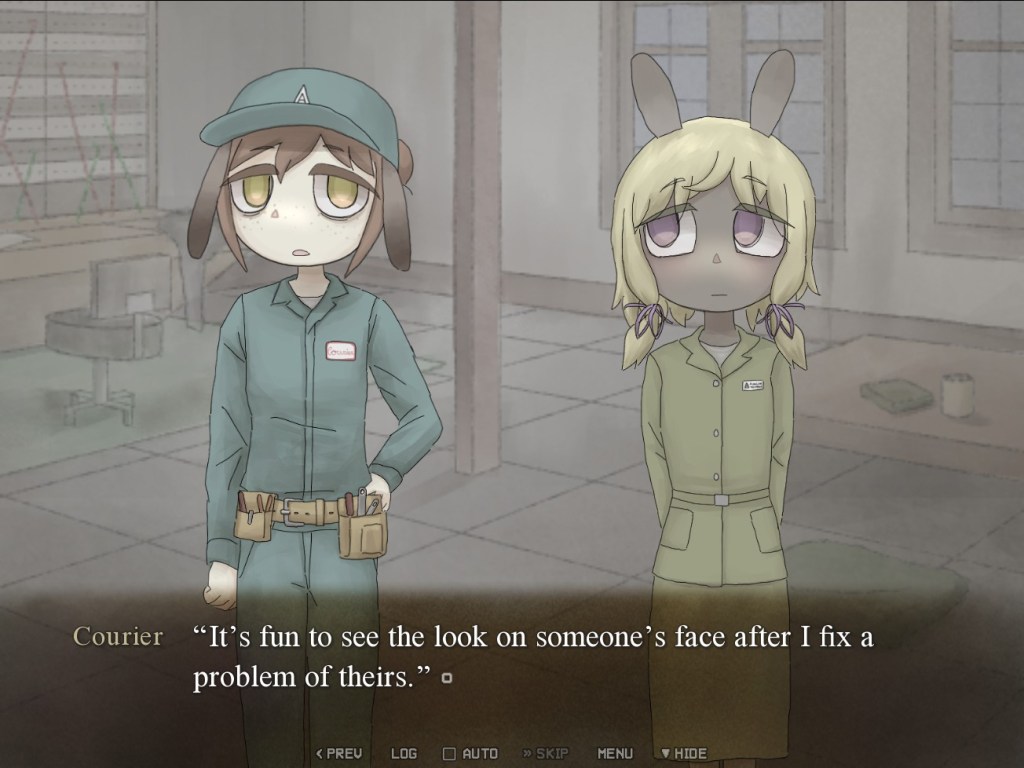
Another great quality of Hello Girl is the character art. It has a distinct style that primarily uses soft colors. Their faces are rounded, their eyes are particularly big, and since they are all bunny girls, they all have bunny ears. The ears are the most interesting part to me. Unlike many series with bunny girls, each character’s ears are different in shape and positioning. Ana’s stand straight up, Courier’s droop to her sides, and one character has hers in a shape that made me actually think she was a dog girl at first. It’s a nice touch given how different real life rabbit ears vary.
Though there aren’t many characters, that gave the devs the opportunity to focus on the ones they had. Ana and Courier each have two different outfits, and they have a nice amount of variety to their expressions. There are a good chunk of CGs with all of them being well drawn and composed. I wish there was an art gallery to look at them after the game is finished, but that’s a minor downside at best.
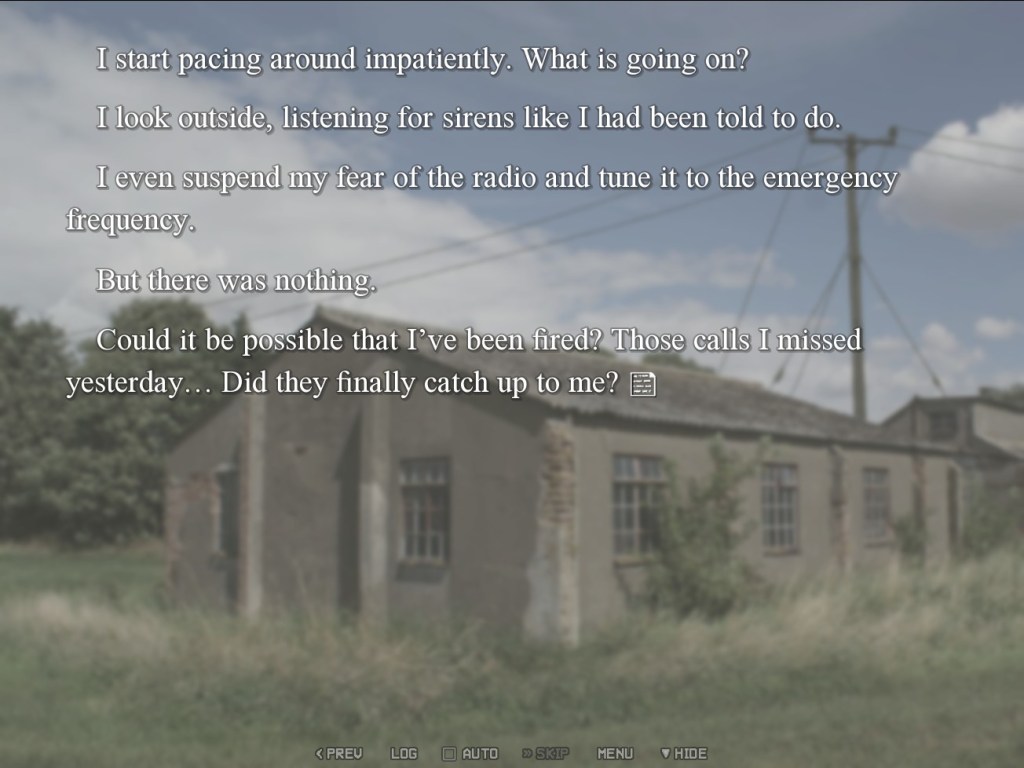
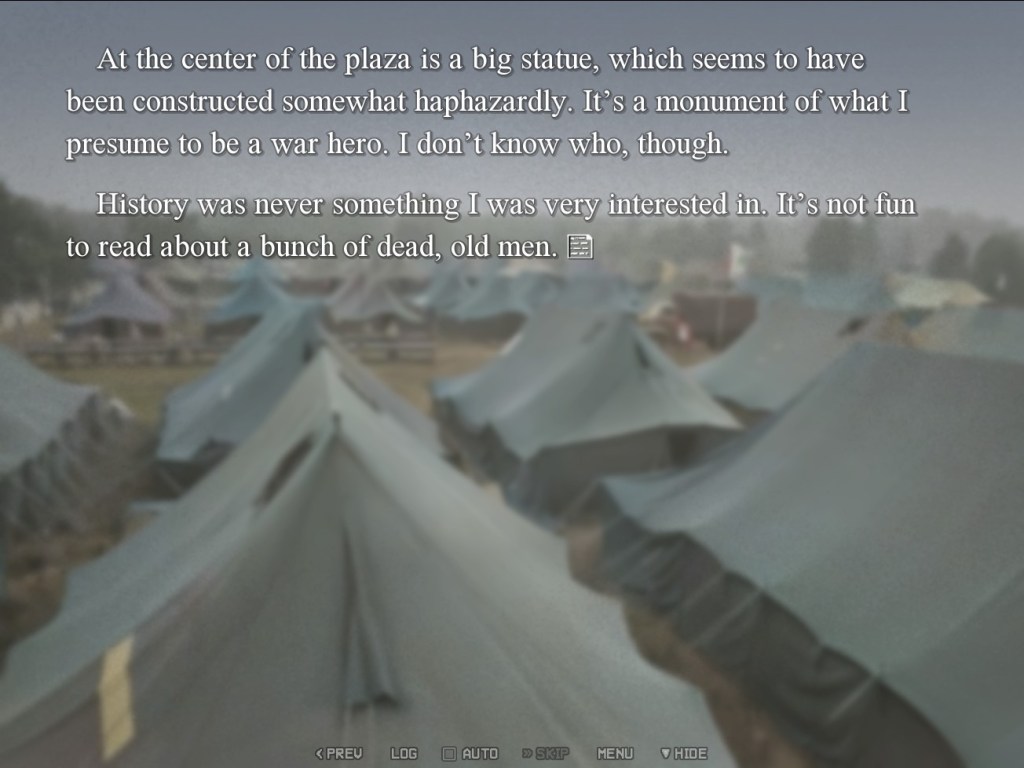
The backgrounds are a mixture of art and images. Usually I’m iffy about real blurred images being used in this way, yet it feels like it works here. Perhaps it is from the countryside setting being complemented by a lot of these pictures. The art used for the other background images is nicely done. There are a lot of backgrounds for this game, more than I expected to be honest. I appreciated that effort, especially for small things like showing Ana’s bike. You barely see that image used, but its presence gives a clearer idea of the difficulties she mentions in using it.
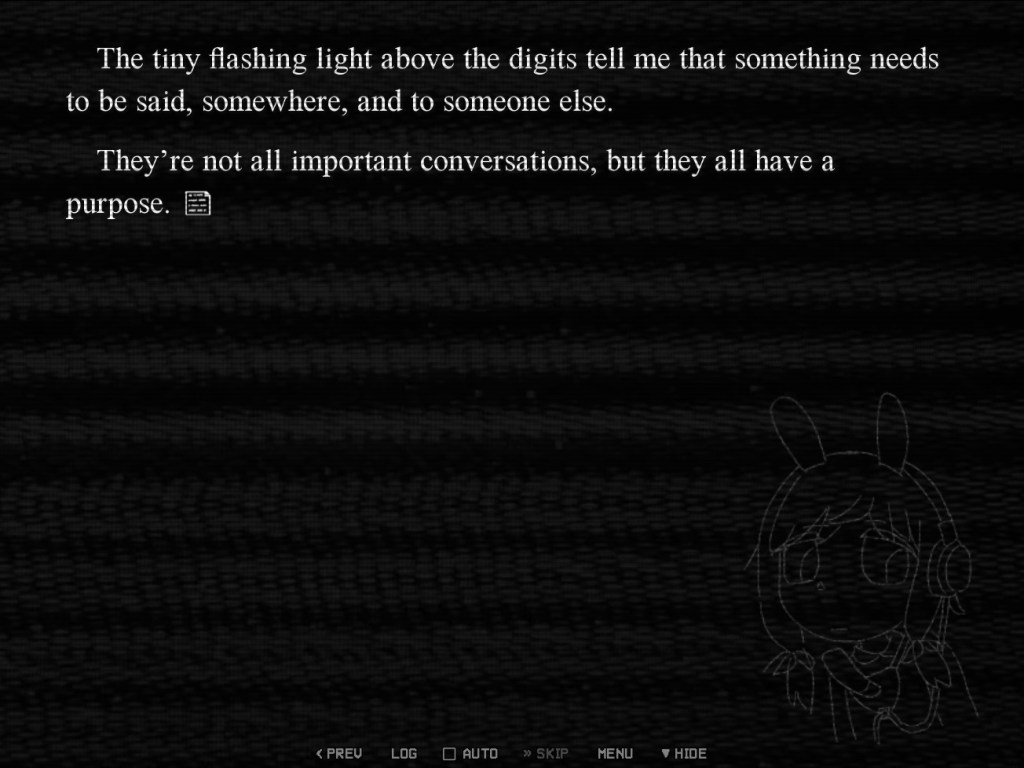
One thing I will warn about is the first small section of the game. It has text that moves back and forth along with video tape static. The former can be disabled in the menu, but the latter can’t. I appreciate the effect that the devs were going for, but I could see it being discomforting for some players. I’d say an average read time for this section would be three to five minutes, and after that, the effect isn’t used again. I wish this section had been a bit shorter, especially since it’s meant to be a creepy hint of things to come. I think a shorter, punchier version would’ve been better, and it would help for players who find the static difficult to deal with. Regardless, I mainly want players to know that if they start the game and have issues with the visuals, it won’t last long.
Sound
Like the other aspects of Hello Girl, the music does a wonderful job of adding to the setting and the emotions tied to it. Many of the tracks lean heavily into the feeling of the countryside, mostly being calm pieces with the main instrument being a guitar. Others have an eerie vibe to go with the creepier moments of the game. I particularly liked the music that had phone noises incorporated, such as dial tones and disconnection beeping. I wound up buying the OST immediately after finishing the game, that’s how much I liked it!
There is no voice acting, and that suits me fine. While great voice acting can elevate an experience, mediocre or poor voice acting can likewise damn it. You could argue that if there was voice acting and a way to turn it off, then that’d solve the possible negatives. If that’s the case, why spend the money and resources on it if players are likely to turn it off? My point is that if there is a choice between having voice acting or strengthening another element of a visual novel, I’ll usually advocate for the latter. As such, this isn’t a negative to me. For players who value voice acting, that’ll be a flaw that I can only hope they’re able to look past.
Gameplay
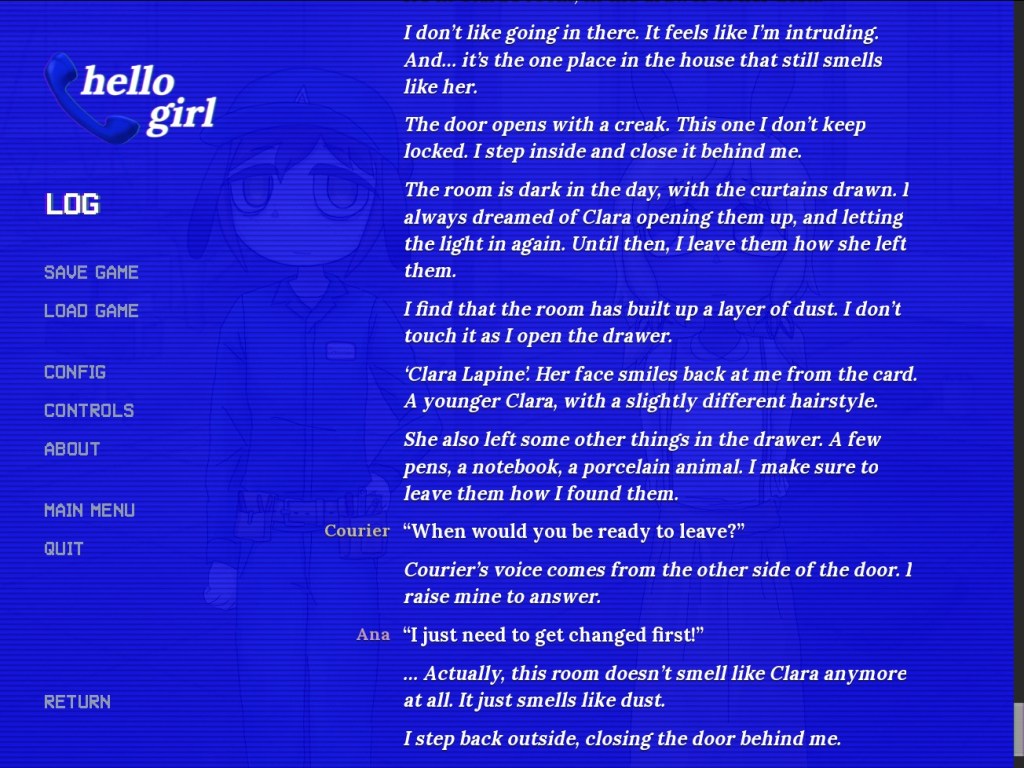
As one would expect from a kinetic visual novel, there is barely anything to say about the gameplay. You click the screen to continue reading the story. For those unfamiliar with the term, ‘kinetic’ in this gaming space means that there are no choices, so the story will always be the same. Hello Girl uses Renpy as its game engine of choice, and as I usually find with said engine, it works well. You can save and load whenever you feel like it, though the game also has several points where it asks if you would like to save. A middle mouse click lets you see the screen without text. The log goes back a long ways, though you can scroll back if you prefer to go back to a certain screen. Something I found a little strange was that the music cut off when accessing the menu. Most visual novels don’t do that. It doesn’t matter one way or another, but I felt like mentioning it since it was odd to me.
Something I like to consider is why the creators of kinetic visual novels choose them as their medium. Many kinetic visual novels feel as though they could be just as well produced, if not more so, as a book. In this case, Hello Girl absolutely makes use of the strengths of its genre. The music, art, and visual effects all add to the setting in ways that are extremely effective and quite different from how they would be with written word alone. It’s hard to explain, but the best way I can put it is that everything in Hello Girl feels like it is an integral part to the experience. Take away one of these and it loses part of what makes it special. I hope you can relate to this feeling, because to me, it’s one of the best feelings you can get from any piece of media.
Some Rambling About Why I Love This Game
If you are the slightest bit interested in trying out Hello Girl for yourself, don’t read this part. If you know you won’t play it, have already played it, or very much want more convincing, then go ahead. There won’t be any outright spoilers, but I feel it’s better to let the game do the talking instead of me trying to boil down its essence. This is more of me wanting to give some of my thoughts that don’t fit anywhere else.
Slightly spoilerish musings (Click here)
I have lived in many locations throughout my life. I’ve always appreciated rural ones more than urban, and Hello Girl’s atmosphere captures those rural aspects so well. Ana’s workspace is also her home, and she has no neighbors whatsoever. She has to use her motorbike to go into town to get rations and pick up her mail, something she usually does once a week or so. Other than knowing the mail person to some extent, she has basically no contact with any people. Her only family member that she is close to is away, and she has no friends to speak of.
This isolation leads to Ana listening in on phone calls while doing her job. There are two sections of the novel where she eavesdrops on a variety of conversations. These dialogue exchanges say a lot about the world without going into too much detail. They also give the reader some introspection on Ana. I really loved these scenes and I wish there had been some more of them. In fact, I wish there had been a short game before this one that was focused solely on this premise. That, or an extended prologue that was just these eavesdropping sessions. I love the direction the game took, but at the same time, it feels like an equally good direction was lost in the process. As it is, the company’s insistence on doing maintenance at her workplace means she is unable to do her job for most of the game, leaving that aspect more limited than I wanted.
What I love about the chosen direction is how heavily it focuses on Ana and Courier. I’m a huge sucker for stories that have two primary characters with strong interactions. Ana’s limited worldview is widened by Courier’s knowledge, and Courier finds Ana to be a refreshingly different person than most she runs into. They have some clashing ideals that leads to minor conflict, but not enough to ever make me think their friendship was in danger. Well, their friendship, or is it something more? The store page does say there might be some yuri, so I won’t deny that the story might go that way. Either way, their relationship is wholesome and I adore it.
There are many stories that focus on the devastation caused by war. Most of these involve following soldiers, or other members of the military. Ana’s job has nothing to do with that. Her sister left to join the war efforts, so Ana sends letters to her while waiting for her to come home. This is a take on how war affects those far from the front lines that I rarely see. Tension creeps into the small idyllic community from the distant fighting. A military branch takes residence nearby with soldiers occasionally patrolling in otherwise peaceful areas. Food is limited, so rations are given to the citizens once a week. One of the phone calls that Ana listens in on is about someone trying to buy flowers for a loved one in the hospital. We don’t need to see the death and destruction caused by the fights. The unease and dread flitting at the edges of the story tells a tale that, in some ways, is even more effective. A lot of war stories don’t affect me as much due to being desensitized to onscreen violence. The implications leave my imagination to wander and think about how bad things could be, especially when nothing confirms the situation. Is the ‘side’ Ana is on winning? Losing? Is there any winning or losing here? It isn’t said, and it doesn’t need to be said. It’s worse that way, and I appreciate how it’s written here.
Everything else I’d like to compliment here is probably going into deep spoiler territory, so I’ll leave it at that. Instead, I’ll finish by posing a question on something rather odd. Why do the soldiers wear school uniforms? It looks like they do, anyway. Is there some lore to this or is it just an excuse to have soldier bunny girls in Japanese school outfits? The world may never know.
Conclusion
It takes special talent to create a world that resonates so strongly to those not living in it. That is what stands out to me most about Hello Girl, and that is why it is now one of my favorite kinetic visual novels. I highly recommend this to anyone even slightly curious about the premise. The developers have stated they are working on a sequel, and I look forward to it with bated breath.
Otome Lovers wishes to thank Imo Team for providing a free review copy of this game.
Abridged review posted on Steam ➞
Please follow our curator page, Otome Lovers, if you’d like to see more reviews like this one!
 Otome Lovers
Leave a comment