
It’s Not You, It’s M.E tries to show the frustration and exhaustion of having ME/CSF via a video game. Its use of generative AI, minuscule playtime, and lackluster gameplay makes it not worth buying.
Introduction
How much value should be placed on capturing an experience in an unusual way? It’s Not You, It’s M.E thinks that it’s worth $1.99 USD. This game lasts about 10-20 minutes (it took me 18 to finish a playthrough) and does its best to convey what it’s like to have ME/CFS in that short period of time. This is an interesting idea, but it unfortunately fails. Here is why.

Story
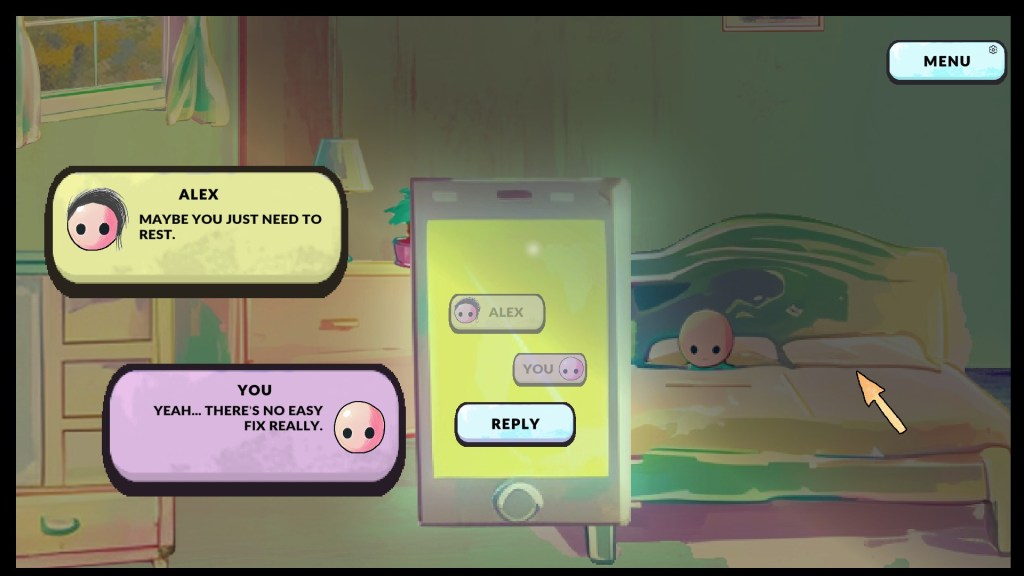
There is enough story to set the stage for the game’s premise and nothing else. You play as someone with myalgic encephalomyelitis, also known as chronic fatigue syndrome. Your character starts off by messaging someone they know to say they’re too tired to go out. They later receive a message from their doctor saying that their blood tests came back with nothing problematic showing. After informing someone from where they work that they will have to stay home for the week, your character tries to get through said week as best as they can.
That’s it. The plot is basically non-existent. To be fair, this game isn’t trying to tell you a traditional story. It more exists to convey a sense of helplessness and frustration through gameplay. As such, I didn’t much care about there being no real plot to speak of. However, I do think it’s odd that there’s a meeting in the middle of the week that isn’t shown at all or even acknowledged if you skip it. That probably should have been left out.
Graphics
I want to say I like the graphics. The art seems nice and the colors are lovely. Unfortunately, I can’t actually say I like them, because this is in the description on the store page: “This game includes some assets that were initially created using generative AI image tools, with each asset individually modified before inclusion.” I have no love for AI in creative spaces barring some very specific exceptions, and this is not one of those exceptions. As such, while the game looks pleasant enough, I’m not offering any kudos here, and I would have not even played the game if I saw that information beforehand.

Sound
The music is mostly generic. There’s a bit of pep in the minigame tracks that strikes me as odd, given how you’re often shown to be exhausted. The sound effects are fine, such as having dishes clinking when you eat and tapping at a keyboard while working. I liked the song in one of the endings. It feels barebones to only write this much about the sound, but it’s also a barebones category in this game, so here we are.
Gameplay
Let me give some context for what your character is suffering through. According to cdc.gov, “ME/CFS is a biological illness that affects many body parts. It causes severe fatigue not improved by rest, problems thinking and sleeping, dizziness, pain, and many other symptoms.” It has been reported that about 3.3 million US citizens have ME/CFS, and there is an estimation of 90% of cases not being formally diagnosed. That should give an idea of how prevalent this condition is; it’s rare enough to not be as well known as other illnesses, but prevalent enough to affect many people.
It’s Not You, It’s M.E tries to portray the difficulties people with ME/CFS suffer from as an interactive experience. This is done by giving your character a certain amount of energy per day. You have to complete as many tasks in your diary as possible. This continues for a week with an overarching goal of at least doing three work sessions. Due to your limited energy and only having so much time each day, you usually cannot finish all of the chores in your diary.
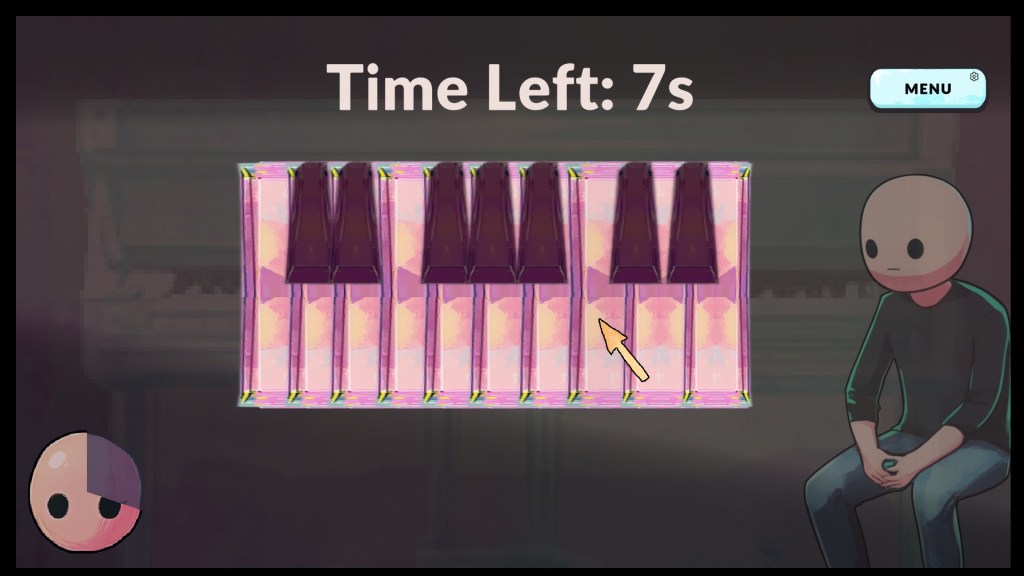
During five of these tasks, a minigame might pop up. These games are: popping bubbles (bathing), taking pills (medication), dispelling clouds of fog (resting), putting food on a plate (snacking), and organizing books (reading). There is also a sixth involving playing the piano, though there is no ‘win’ condition for that one. You simply click on the objects/drag them depending on which game you are playing. How much time you have to complete each game is based on your energy level, with a higher energy level giving you more time (usually thirty seconds maximum). If your energy level is too low, you can’t win these minigames due to how little time you have (around five seconds or less). Upon game completion, you can get two different ending screens, and I believe one is only possible if you have enough energy at the end. Other than that, trying to win these minigames or conserving energy doesn’t appear to matter.

Having gameplay that is geared around impossibility reminds me of two other games I have played. One was Depression Quest, which has… issues of its own, to say the least. That aside, it did portray depression in an interesting fashion by showing what someone with depression would like to do while greying out the option, making it impossible if your character wasn’t in the right headspace. The other is actually another game focused on ME/CFS called Robin. That game came out in 2018, did a similar concept within three days as opposed to a week, and was quite good. It took about half an hour for me to do everything I wanted in it. It’s also free, so I highly recommend checking that game out to anyone interested.
I bring these up because I do think it’s an intriguing idea on how to portray ME/CFS. However, I didn’t feel as interested in its portrayal in It’s Not You, It’s M.E. Perhaps it’s because the minigames feel a bit too out there for my tastes. Catching pills in the air feels weird to symbolize trying to count what you need, for instance. I didn’t get why there were balloons flying around in a lot of the minigames. I also wasn’t sure about how the tasks were split up in terms of energy and time spent. The idea of all these seemingly simple tasks taking a long time is solid. People with ME/CFS are going to struggle to get dressed, brush their teeth, do the dishes, and all the other tasks in the game. It’s still not likely to take someone with this illness the same amount of time to get dressed as it is to do those dishes, or to take the same amount of time to eat a snack as it is to do a day’s worth of work.
I don’t have ME/CFS so I could be wrong about all this. What I do have is depression, and it affects me in a way that makes it easy to sympathize (perhaps even empathize) with what is portrayed in this game. It does feel like a monumental task to do even the smallest things. Why struggle to get dressed if you’re just staying home anyway? Do you really have to brush your teeth today? Is it that important to get a shower? These are thoughts I constantly deal with despite knowing that, logically, they shouldn’t take much time at all. I recognize the game’s attempts to universally show what these symptoms are like, but if I didn’t have depression, I don’t know if it would have even partially landed. As it is, the efforts here fell short.
If none of this much matters to you, let me also warn you of a bug I ran into. Whenever I tried to do a daily task of resting on the sofa, if I got a minigame, then it wouldn’t count as me resting after that. The other minigames counted as completing the tasks.

Conclusion
As an incredibly short game with AI generated assets and a $1.99 USD price tag, I absolutely cannot recommend It’s Not You, It’s M.E. Despite appreciating the effort to showcase what ME/CFS is like, it wasn’t done well enough to impress me. If AI wasn’t in the mix, I might have been curious to see if the dev improved with future games and experience. Even without AI, the game would need a lot of work to be worth its price tag.

A key was provided by the developer to Otome Lovers for review purposes.
Please follow our curator page, Otome Lovers, if you’d like to see more reviews like this one!

 Otome Lovers
Leave a comment