
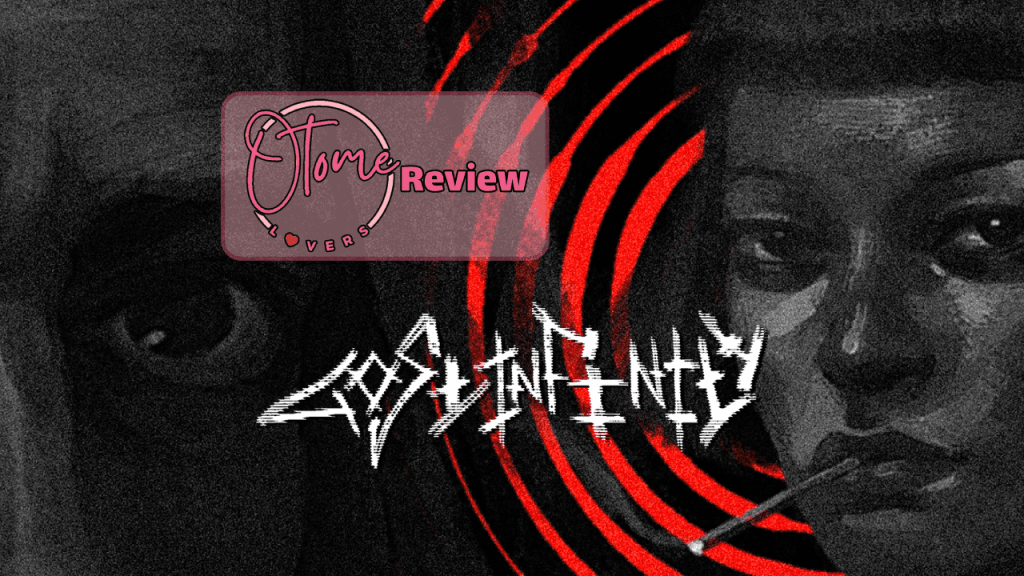
Lost Infinity is a visual novel with fascinating art and desolate ambiance. The spotty translation is an acceptable trade-off for its great atmosphere and interesting quandaries.
Introduction
When I play a visual novel, I usually do so for story and characterization. However, there are exceptions. Some visual novels are so well constructed in their other areas that they’re worth experiencing for those alone. Lost Infinity falls in this category. It’s an odd and intriguing game that I liked the writing for, but found stronger in its atmospheric set-up. I’ll do my best to explain why.
Story
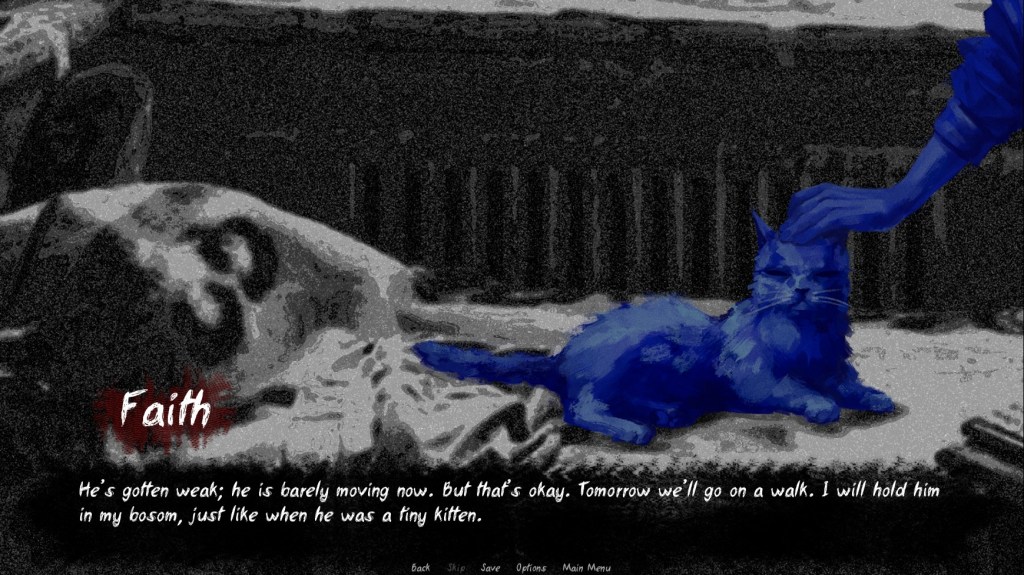
Lost Infinity introduces you to Faith, a man who is disillusioned by the world he lives in. He finds the body of a woman on the ground and decides to bury her. This is not easily done, for the city he lives in has ground that cannot be dug into. Thus, Faith sets out to find a location to lay the woman to rest, and your character (no default name) accompanies him.
This isn’t a visual novel that cares much for its narrative. The focus isn’t on a plot, but on questions that humanity has asked itself time and time again. Would you rather live forever, or pass on when the time is right? Is it better to dream, or should you accept the reality you live in? Which do you care for more, dogs or cats? (The answer is both but that sadly isn’t available here.) None of these important queries are new, but they are phrased in interesting ways. They give the reader something to think about if nothing else.
Graphics
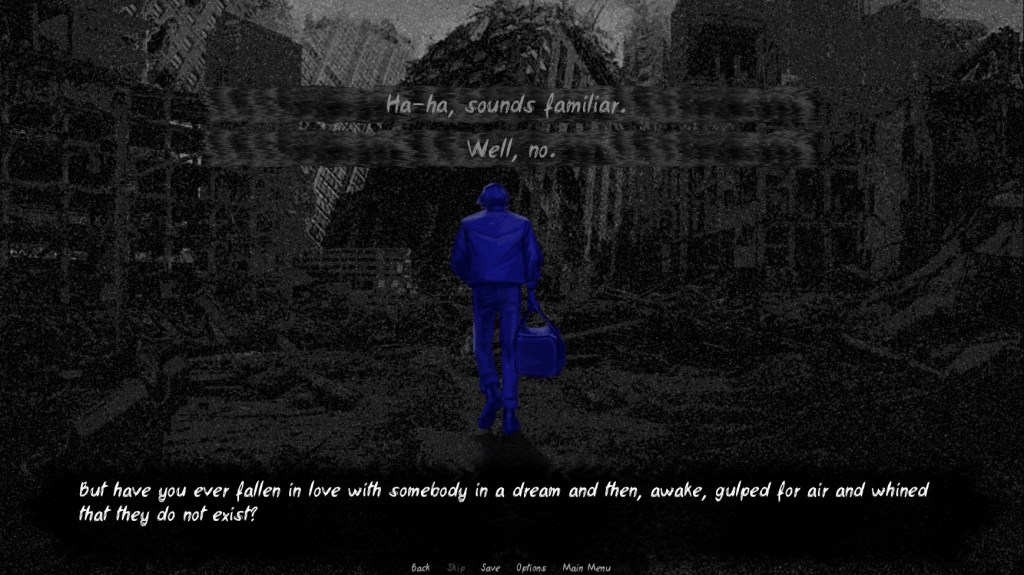
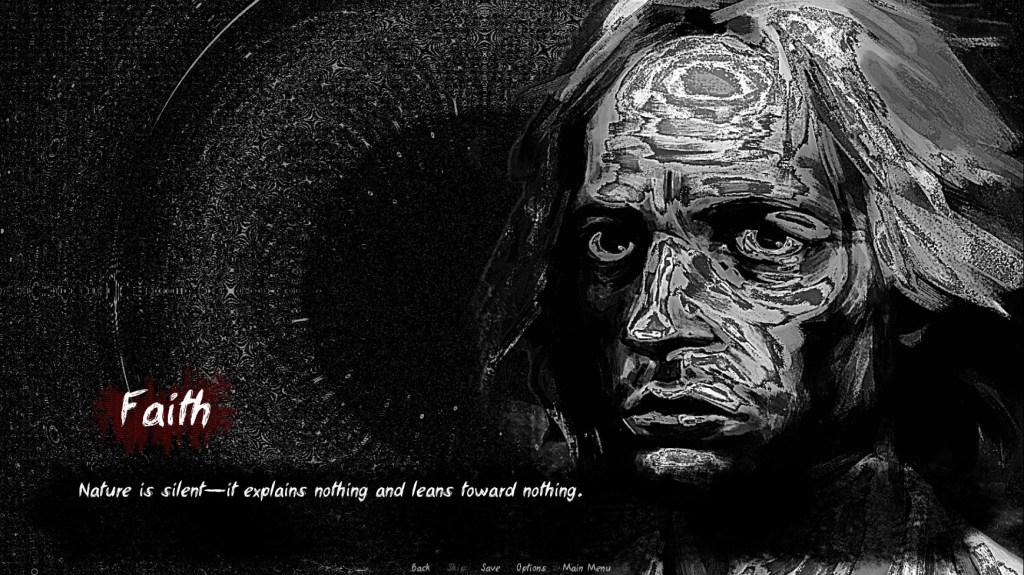
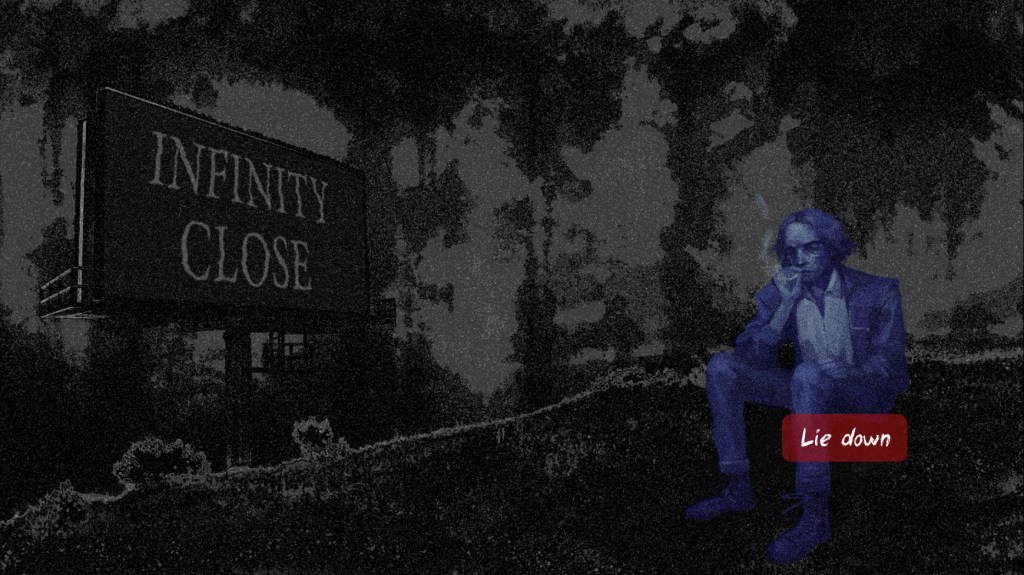
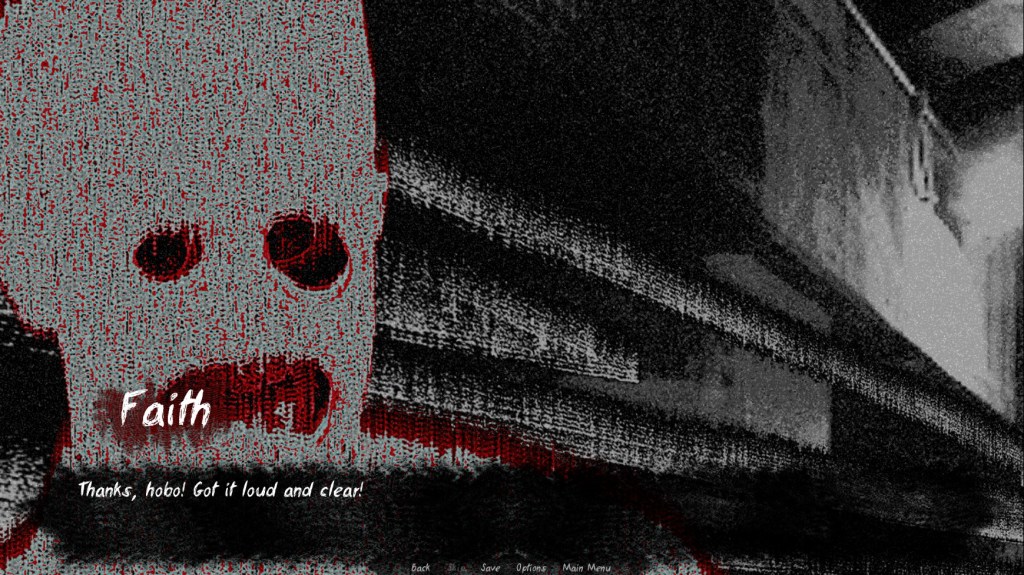
This is the main reason to play Lost Infinity. Its art style gives an atmosphere to this visual novel that I doubt it could otherwise capture. The two main human portraits are drawn in a realistic way, though not so much that they would be mistaken for photographs. In contrast to the clearly portrayed humans, the backgrounds are deliberately fuzzy, using light static to give them a feeling of separation. There are sections that use surreal imagery, and these tended to leave me with a mixture of disturbance and fascination. It’s very difficult to explain how well this works for the setting without showing the art itself. I have included some images in the website version of this review; hopefully that helps.
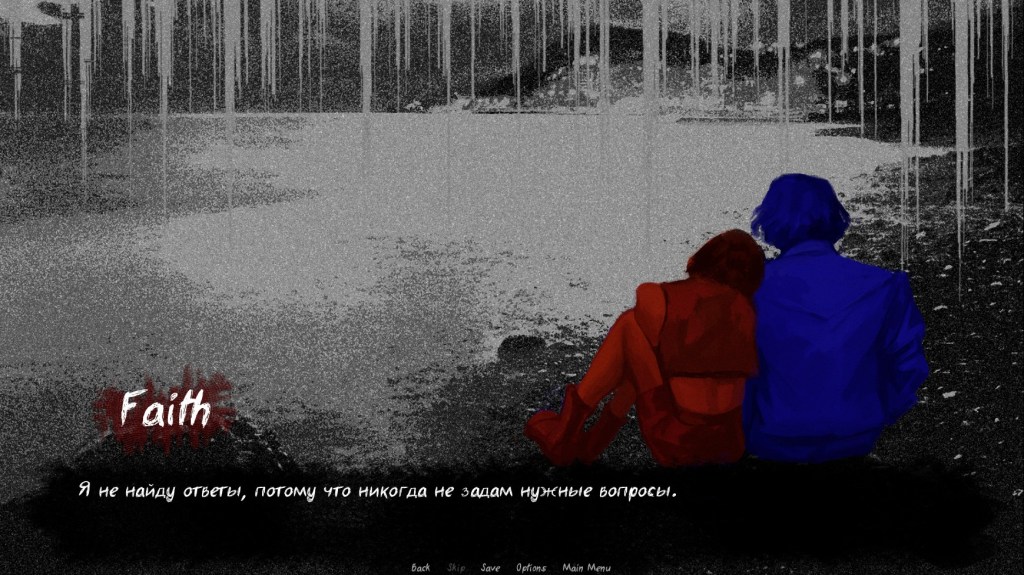
I also liked the use of color. Most of the game is monochromatic, using various shades of gray to lay out its landscapes. Faith, his cat, and some objects are blue, making them stand out and linking them to Faith himself. “She” is the only person that is purely red, showcasing the fixation Faith has in her. There are a couple of other instances of colors, but they are minor and mainly serve as enhancement for unusual sights. The main appeal to the coloring is how desolate it makes the world feel. You can tell it is a doomed city, perhaps even a doomed world. Only the non-gray objects are able to be clearly distinguished, leaving the rest an eerie haze.
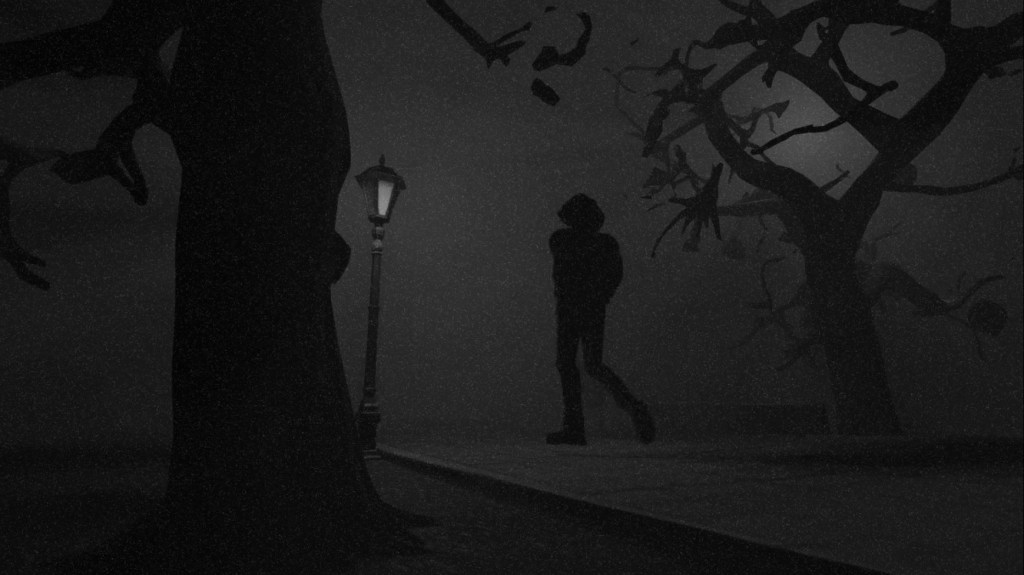
A much stranger choice was the use of 3D segments. Occasionally the game would show Faith walking from one location to another in 3D. I’m not sure why these segments exist. They’re certainly interesting in appearance, foregoing any other color for purely gray tones and having Faith as a dark figure without features. There doesn’t seem to be much purpose though, unless I’m missing some kind of symbolism from these short sections.
Sound
The music in Lost Infinity is subdued. It adds to the sensation of loneliness and fits the gloomy landscape. The soundtrack works well, though I wouldn’t find it particularly compelling to listen to outside of the game. My only complaint is that at least one of the tracks has a pretty obvious loop point, though most of them fortunately do not.
There are sound effects for different areas as well. This includes waves crashing, birds chirping, and people murmuring. While that may not seem like much, these noises add to each location. The artwork is most important for setting the stage, but without the music and sound effects, Lost Infinity would not be nearly as effective at invoking the setting that it does.
There is no voice acting in this game. As per usual for me, I’m good with this. It would’ve been quite a bit of talking from Faith’s voice actor if he had one, as he’s the one talking for the vast majority of the story. I’m sure that could be done well, but it definitely isn’t needed here.
Gameplay
As one would expect from most visual novels, there is not a lot of gameplay to talk about. The main interactions you have are when you are given choices. Faith spends the journey waxing philosophically to you, and you choose how to respond to his questions. These can lead to two different endings, with one being rather strict about the answers you give and the other being more of a default ending. The storyline remains the same structure-wise regardless of your choices, though the differing dialogue that Faith has makes it worth trying out each choice.
There are some sections where you have to click on a part of whatever background is present to move the story along. The first example of this opens the game, as you have to click “Stand up” to proceed. I assume these are in the game to showcase the actions Faith is taking, as it would be odd for him to say his movements out loud. Since there is no omniscient narrator, this works. I’m noting it more because it stood out to me and was different from other visual novels I’ve played.
As with many visual novels, Lost Infinity uses Ren’py, and it works smoothly. You get a lot of save slots, and you can save and load at any point. While you can go back in dialogue, there unfortunately does not seem to be a log function. There also isn’t any sort of gallery for CGs. That being said, there aren’t really CGs in the traditional sense, so I can see why there is no need for such a feature. I just like to mention whether visual novels have those or not since they’re usually a nice addition. This is one of the exceptions to that.
What I do have to criticize the game for is its stiff translation. Since it was originally written in Russian, the wording in its native language might be better. The English translation is mostly understandable, but it doesn’t flow as naturally as it could. That’s not accounting for the several typos I found. While I still understood what Faith was saying, they definitely didn’t help.
There are also a few instances where the lines aren’t translated. It’s especially unfortunate that this happens at the first choice, which as far as I can tell probably is asking something like, “By the way, do you prefer cats or dogs?” That’s just a guess, but it’d make sense in context. The other lines don’t relate to choices. That being said, they’re still jarring to see and should be fixed.
Conclusion
Lost Infinity’s excellent graphics and great sound design makes for a memorable experience. I would say its asking price of $0.99 USD is more than reasonable for its artwork alone. Though you’re likely to only spend an hour or so on this visual novel, that serves it well. You are given an unsettling dystopian world and some food for thought without it overstaying its welcome. I recommend giving it a try for its unique experience if nothing else.
Otome Lovers wishes to thank Void Echo and Mee:w for providing a free review copy of this game.
Please follow our curator page, Otome Lovers, if you’d like to see more reviews like this one!

 Otome Lovers
Leave a comment