
Paper Pusher has you choose which citizens live and die through the government forms they submit. The dystopian setting and intriguing premise make for a disturbing, though short, experience.
Introduction
Psychological horror is a genre that is often associated with disturbing monsters, sinister landscapes, and plenty of spine-chilling scares. Yet not all psychological horror focuses on these aspects, and Paper Pusher is one of them. Sure, this game has monsters in the forms of the government and those who abuse the system, and its office setting could bring horror in any 9-5 worker, but that’s not the same as others of its genre. The scary part comes from how you are being paid to execute people, and the toll that takes on one’s soul.
Story
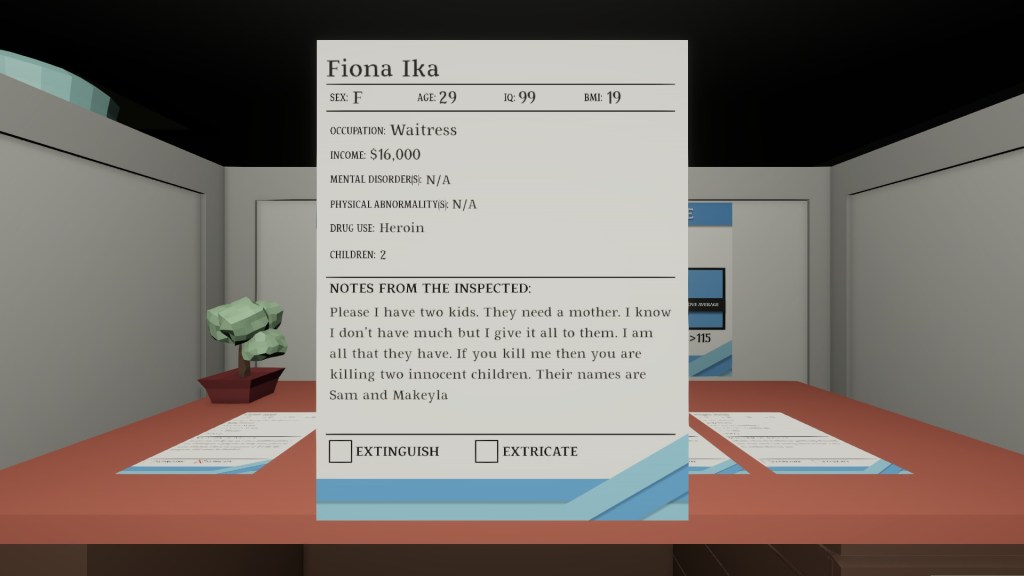
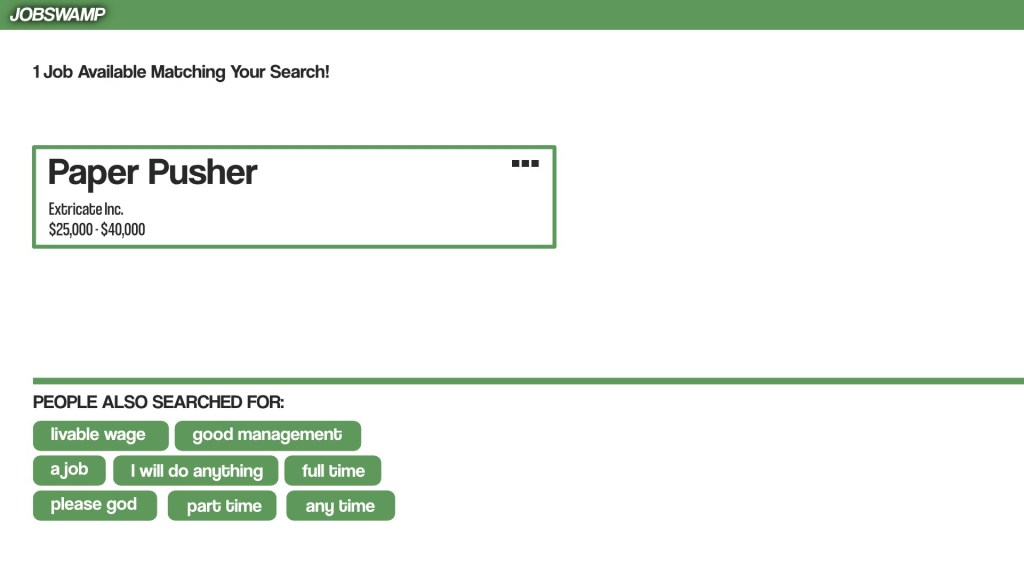
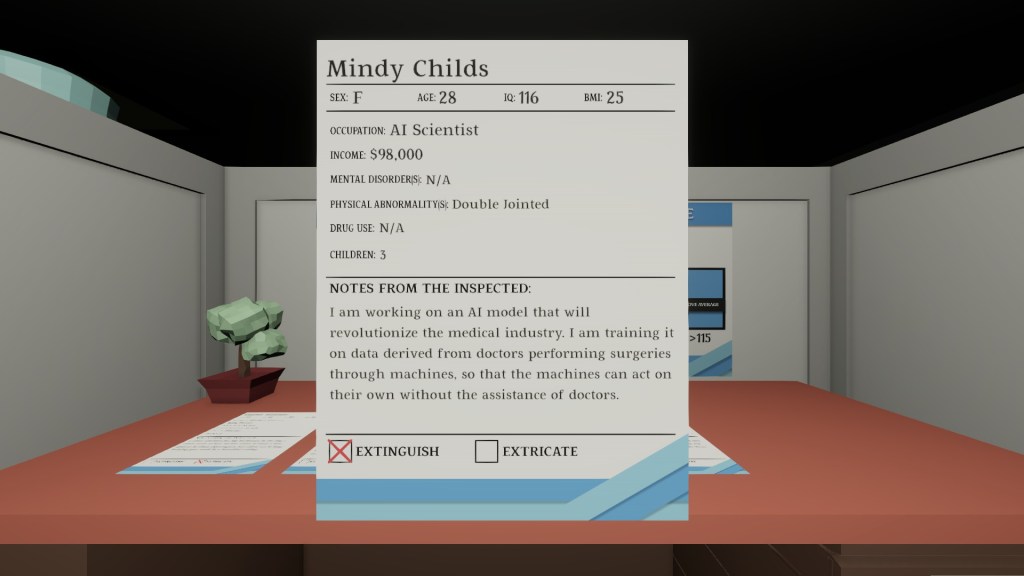
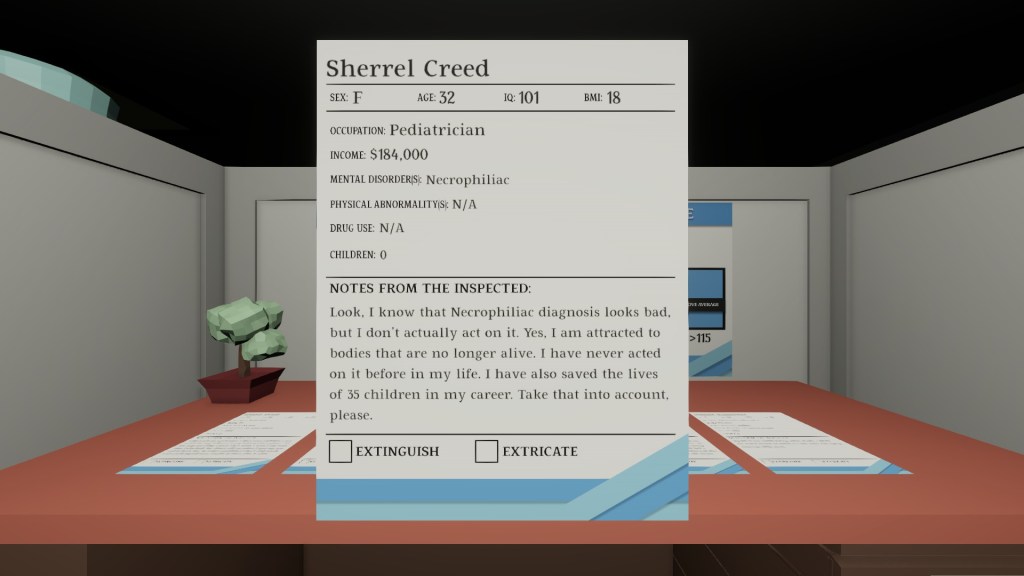
You play as a jobless sap who is willing to take on any work. The only option available is to become a paper pusher (hey that’s the title of the game!) for Extricate Inc., a company that works for the government. That’s bad enough news, but it gets all the worse when you realize you’re in a dystopia. This world has everyone fill out forms detailing their age, IQ, BMI, and other traits to show their value to society. Add in the space where they get to write why they should be spared (or not, in the case of some) and you’re left with a dilemma. Who do you decide to Extinguish, and who do you decide to Extricate?
There isn’t a plot so much as a series of days with some scheduled events. You’ve been hired for ten days and have to go through five papers a day, along with sometimes getting a letter from one of the very few prominent characters. The lack of a plot and central characters works for this style of game. The focus is on how you weigh the lives of the people you are asked to judge. For each of the five forms you are given, you must mark at least three with Extinguish. Whether you weigh these lives by the benefits they bring to society or by your own values is up to you.
Graphics
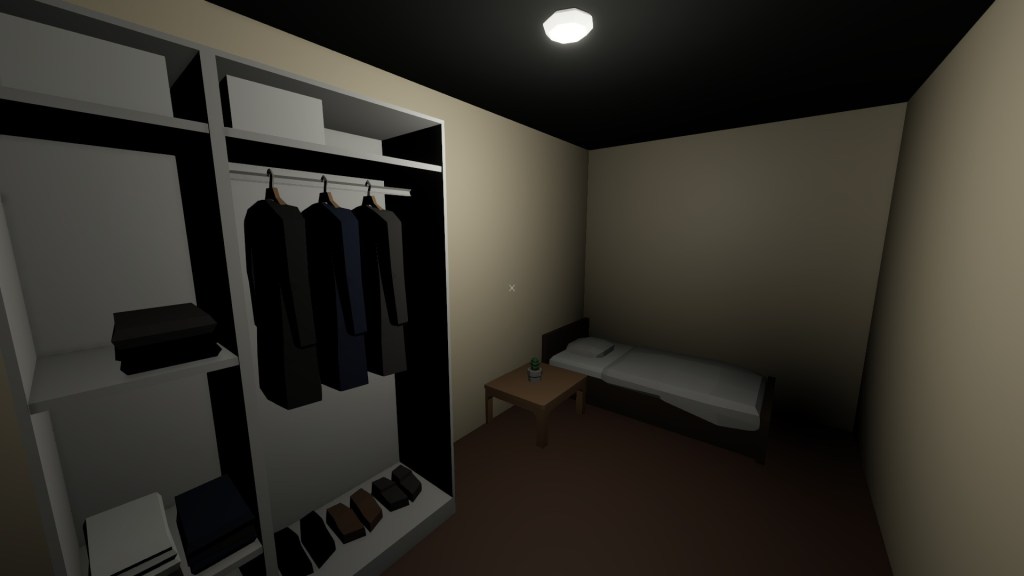
The graphical style in Paper Pusher is of blocky 3D assets. This gives it less of a realistic edge. While nothing special, the graphics do their job. Since the focus is on the forms you’re looking at, I prefer the development effort going into the writing on said forms over making the building pretty. Besides, that would defeat the purpose of a temporary corporate job. Why would they spend their millions of dollars on your barely-lived-in apartment?
Sound
Paper Pusher has no soundtrack, something that I would usually find problematic. Music brings so many layers to games and really adds to the atmosphere. However, the lack of music here is an atmospheric choice in itself. You are in a silent building, far from any other workers that might be present on other floors. The eerie quiet as you go to work and back leaves an eerie sensation that works well. Thus, this is one of the rare times I appreciate there not being music in a video game.
Without characters to interact directly with, there’s no need for voice acting. There are some sound effects, though not many. You ding the desk bell when you finish work for the day, the elevator whirs when it moves, and the game system you can play has some beeps and boops. I wish that there were footsteps for when you walked, because when I’m alone in a building, that’s what makes me really notice how isolated I am. Otherwise, no complaints here.
Gameplay
As one might expect from a simple concept of working on forms, there is not much to the gameplay here. You have to type in a job application at the start, otherwise no typing is necessary. To get to and from your job, you use WASD to walk, and thankfully it’s at a brisk pace. E interacts with certain items, such as allowing you to read letters and to sit on a chair. You click on the forms to pick them up and to check the Extinguish or Extricate box on each. The latter is one of the only grievances I have with Paper Pusher. Sometimes when I thought I had my mouse pointer on a box and clicked it, the game would instead think I was clicking the form. Clicking on a form causes your character to put it back down. That meant I’d have to pick it back up and try clicking the box again. It’s not a big deal, but I did get annoyed when it kept happening. Bigger boxes for marking the forms might have helped.
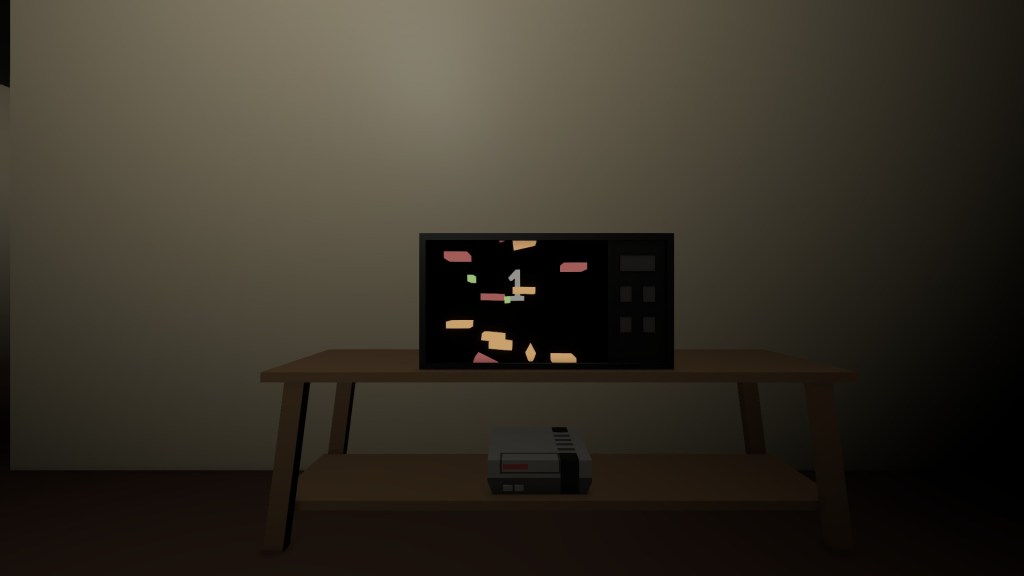
There’s a minigame that you can play on a legally distinct NES in your apartment. All you do is move back and forth to pick up green boxes that drop from the sky while pushing aside orange ones and avoiding red ones. It’s a nice optional thing to have, but I got bored of it quickly. That’s most likely the point; it’s showcasing that the corporation is doing the absolute minimum to provide your character entertainment during their stay.
Depending on certain decisions you make, you can get a variety of endings. I discovered four during my six playthroughs (the latter two having some differences in gameplay narration but not the endings themselves). It’s very quick to go through the game again, though your first playthrough will probably be about forty-five minutes to an hour. Unfortunately, there is no save option, but if you have to quit out, it’s not difficult to get back to where you were. Pressing the Escape key will give you a very limited menu. Look Sensitivity and Sound Volume are as implied, yet for some reason Music Volume is there too. Trying to adjust it is useless because it resets when you leave the menu. And because, ya know, there’s no music.
Joking aside, what could be tedious gameplay is made compelling because of the contents on each form. Do you save a rich programmer who could bring change to the world, or do you prioritize a young waitress because she has two children that need her to survive? Is it for the best to let someone with Alzheimer’s go when someone else is volunteering to die instead? What about the janitor, who does menial jobs that could theoretically be easily replaced, yet are important jobs nonetheless? These are the first five people you have to decide between, and there are many other rough decisions to follow. A nice bonus is that the end of the game will show the statistics of who you chose to Extinguish and who you chose to Extricate, giving you something of an idea of how certain aspects may have affected your choices.
Conclusion
For the low price of free, Paper Pusher is absolutely worth a playthrough. It’s got a disturbing concept that made me question what value I would put on a human’s life, especially when compared to other individuals. Once you add in the small moments of hilarity and the slightly creepy setting, you’ve got a well-balanced emotional spread. I look forward to seeing what else this dev does in the future, especially if their take on psychological horror continues to differ from the norm.
A key was provided by Phillip Hubbard to The Butterfly Effects for review purposes.
Please follow our curator page, Otome Lovers, if you’d like to see more reviews like this one!




 Otome Lovers
Leave a comment